USDA Hardiness Zone 8a
Frost Dates for 27526 — Fuquay Varina, North Carolina
NOAA 1991–2020 normals from New Hill, NC (320 ft), 10 miles northwest.
Updated
In Fuquay Varina, the last spring frost (32°F) is around April 6 in half of years and has passed by April 21 in nine years out of ten. The first fall frost comes around November 3, as early as October 23 one year in ten, leaving a typical freeze-free season of 209 days (NOAA, New Hill, NC).
- Last spring frost
- April 6
- First fall frost
- November 3
- Growing season
- 209 days
- Hardiness zone
- 8a
50% probability
50% probability
freeze-free, 50%
10 to 15°F (-12.2 to -9.4°C) coldest night
- First snow
- Rare
- Last snow
- Rare
- Winters with snow
- 35%
- Snow per year
- —
median, 1991–2020
median, 1991–2020
7 of 20 observed
NOAA normal
Frost risk by date in Fuquay Varina
Half of springs at New Hill, NC see their last 32°F night by April 6; only one in ten is past it by March 21, and one in ten still has one after April 21. Planting tender crops after April 13 leaves a 30% risk of a frost on them, after April 17 20%, and after April 21 10%. The 15 days between the even-odds date and the one-in-ten date is narrower than at 57% of the 173 North Carolina stations behind this site's ZIP pages.
In fall the first 32°F night comes by November 3 in half of years, as early as October 23 one year in ten, and holds off past November 15 one year in ten. A hard freeze of 28°F follows 10 days later, around November 13; in spring the one-in-ten date for 28°F is April 13, 8 days before the 32°F one. The freeze-free season lasts 209 days in a typical year, shorter than at 60% of the 173 North Carolina stations; it reaches 231 days one year in ten and falls short of 191 one year in ten. On average 89 nights a year drop to 32°F or below. Nights of 36°F, when frost can still settle on leaves in low, open spots, continue 13 days longer, to about April 19, and return around October 26. Severe cold of 16°F or below comes in 93% of winters, usually between January 3 and February 4.
| Low | 90% | 80% | 70% | 60% | 50% | 40% | 30% | 20% | 10% |
|---|---|---|---|---|---|---|---|---|---|
| 36°F | Apr 4 | Apr 10 | Apr 14 | Apr 17 | Apr 19 | Apr 22 | Apr 25 | Apr 29 | May 4 |
| 32°F | Mar 21 | Mar 28 | Apr 1 | Apr 3 | Apr 6 | Apr 10 | Apr 13 | Apr 17 | Apr 21 |
| 28°F | Mar 10 | Mar 16 | Mar 20 | Mar 24 | Mar 28 | Mar 31 | Apr 2 | Apr 6 | Apr 13 |
| 24°F | Feb 23 | Mar 1 | Mar 5 | Mar 10 | Mar 15 | Mar 18 | Mar 22 | Mar 28 | Apr 1 |
| 20°F | Jan 27 | Feb 4 | Feb 13 | Feb 23 | Feb 28 | Mar 3 | Mar 8 | Mar 14 | Mar 21 |
| 16°F93% of yrs | Jan 8 | Jan 18 | Jan 26 | Jan 31 | Feb 4 | Feb 13 | Feb 24 | Mar 1 | Mar 9 |
| Low | 10% | 20% | 30% | 40% | 50% | 60% | 70% | 80% | 90% |
|---|---|---|---|---|---|---|---|---|---|
| 36°F | Oct 16 | Oct 20 | Oct 22 | Oct 25 | Oct 26 | Oct 29 | Oct 31 | Nov 2 | Nov 6 |
| 32°F | Oct 23 | Oct 27 | Oct 31 | Nov 1 | Nov 3 | Nov 5 | Nov 8 | Nov 11 | Nov 15 |
| 28°F | Nov 1 | Nov 5 | Nov 7 | Nov 10 | Nov 13 | Nov 16 | Nov 19 | Nov 23 | Dec 1 |
| 24°F | Nov 8 | Nov 13 | Nov 17 | Nov 20 | Nov 25 | Nov 29 | Dec 3 | Dec 8 | Dec 21 |
| 20°F | Nov 20 | Nov 28 | Dec 2 | Dec 7 | Dec 13 | Dec 22 | Dec 29 | Jan 3 | Jan 11 |
| 16°F93% of yrs | Dec 7 | Dec 17 | Dec 26 | Dec 31 | Jan 3 | Jan 8 | Jan 13 | Jan 18 | Jan 29 |
Freeze probabilities 1991–2020 at New Hill, NC, from NOAA NCEI U.S. Climate Normals. Where a temperature is reached in fewer than 99.5% of years, the dates describe only the years that reach it. Not a forecast.
Frost risk on any date in 27526 →Compare Fuquay Varina with another place →
Frost risk through the year in Fuquay Varina
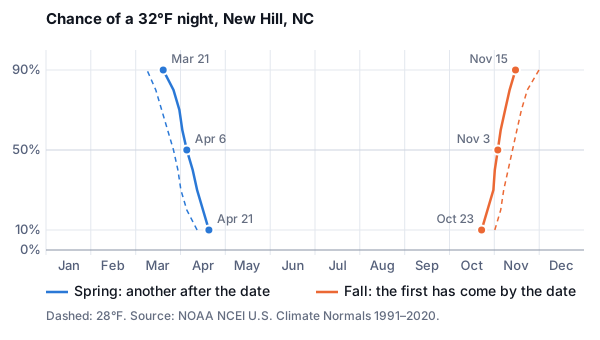
In Fuquay Varina, the spring curve drops under 10% on April 21 and the fall curve passes 10% on October 23, 185 days later; that gap is shorter than at 56% of the 172 North Carolina stations with frost dates. The spring risk falls from 90% to 10% over 31 days (March 21 to April 21) and the fall risk climbs from 10% to 90% over 23 days (October 23 to November 15): the last frost moves more from year to year than the first. At Cary, NC, 10 miles north, the same gap runs from April 12 to October 30, 16 days longer.
| Planted on | Another 32°F night | 28°F night |
|---|---|---|
| Mar 23 | 87% | 63% |
| Mar 30 | 75% | 43% |
| Apr 650% date | 50% | 20% |
| Apr 13 | 30% | under 10% |
| Apr 20 | 13% | under 10% |
| Apr 27 | under 10% | under 10% |
Weather by month in Fuquay Varina
July is the warmest month at New Hill, NC, averaging 89°F by day and 68°F at night; January is the coldest at 51°F and 28°F. A freezing night is all but certain in every month from November to March (a 90% chance or more). From May to September the chance of a 32°F night stays under 10% each month. In spring, April still brings one in 71% of years.
Warmth for growing adds up to 4,538 growing degree days a year (base 50°F), fewer than at 56% of the 173 North Carolina stations. 38% of them (1,725) have built up by the end of June, and July adds the most, 888.
| Month | High °F | Low °F | 32°F night | Nights ≤ 32°F | GDD 50°F |
|---|---|---|---|---|---|
| Jan | 51 | 28 | 100% | 23 | 24 |
| Feb | 55 | 30 | 100% | 18 | 40 |
| Mar | 62 | 36 | 98% | 13 | 112 |
| Apr | 72 | 45 | 71% | 4 | 279 |
| May | 79 | 55 | 1% | 0 | 532 |
| Jun | 86 | 63 | 0% | 0 | 738 |
| Jul | 89 | 68 | 0% | 0 | 888 |
| Aug | 88 | 66 | 0% | 0 | 831 |
| Sep | 82 | 60 | 0% | 0 | 631 |
| Oct | 72 | 48 | 35% | 1 | 333 |
| Nov | 62 | 37 | 99% | 13 | 91 |
| Dec | 54 | 31 | 99% | 19 | 39 |
Monthly normals 1991–2020 at New Hill, NC (320 ft), NOAA NCEI. "32°F night": chance of at least one in the month. GDD: growing degree days, base 50°F.
Compared with the next station
The nearest other station, Cary, NC, 10 miles north of Fuquay Varina, has a last frost 6 days earlier (March 31), a first frost 7 days later (November 10), a season 17 days longer.
When it snows in Fuquay Varina, North Carolina
Measurable snow is rare here: only 7 of 20 winters from 1991 to 2020 recorded 0.1 inch or more at Raleigh 4 SW, NC, 12.6 miles away, so there is no typical first-snow date to plan around.
Planting calendar for 27526
| When | What to do |
|---|---|
| January 26 – February 9 | Start peppers and aubergines indoorsThey need eight to ten weeks under lights before they can go out. |
| February 9 – February 23 | Start tomatoes indoorsSix to eight weeks gives a transplant big enough to set fruit early. |
| March 9 – March 23 | Sow peas, spinach, lettuce, radish outdoorsThese tolerate light frost and prefer to germinate in cool soil. |
| April 6 onward | Transplant tomatoes, peppers, basil, squash, cucumbersThe average last freeze has passed — still watch the actual forecast. |
| by August 11 | Sow the autumn crop of carrots, beets and brassicasThey need about twelve weeks to size up before growth stops. |
| by October 20 | Harvest tender crops, or be ready to cover themA first freeze two weeks early is well within normal variation. |
| November 3 onward | Plant garlic, mulch beds, lift tender bulbsGarlic wants a cold spell; bare soil loses structure over winter. |
The weeks before and after the 50% dates are general rules of thumb, not NOAA figures; a seed packet gives the timing for each variety.
Where these figures come from
ZIP 27526 is 10 miles from New Hill, NC, which stands at 320 feet, the nearest NOAA station that publishes freeze probabilities for 1991–2020. 2 other ZIP codes share the station. The 2023 USDA Plant Hardiness Zone Map lists ZIP 27526 in zone 8a, the band where the coldest night of the year averaged 10 to 15°F (-12.2 to -9.4°C) over 1991–2020; a zone describes winter lows, not frost dates.
Frost dates across North Carolina →
Hardiness zone and temperature range: USDA Plant Hardiness Zone Map 2023 (USDA-ARS, Oregon State University), ZIP-code listing, unchanged. °C converted from °F by this site.
Thirty-year averages, not a forecast: check the forecast before planting out. How stations are matched and which pages are offered to search engines: methodology.